
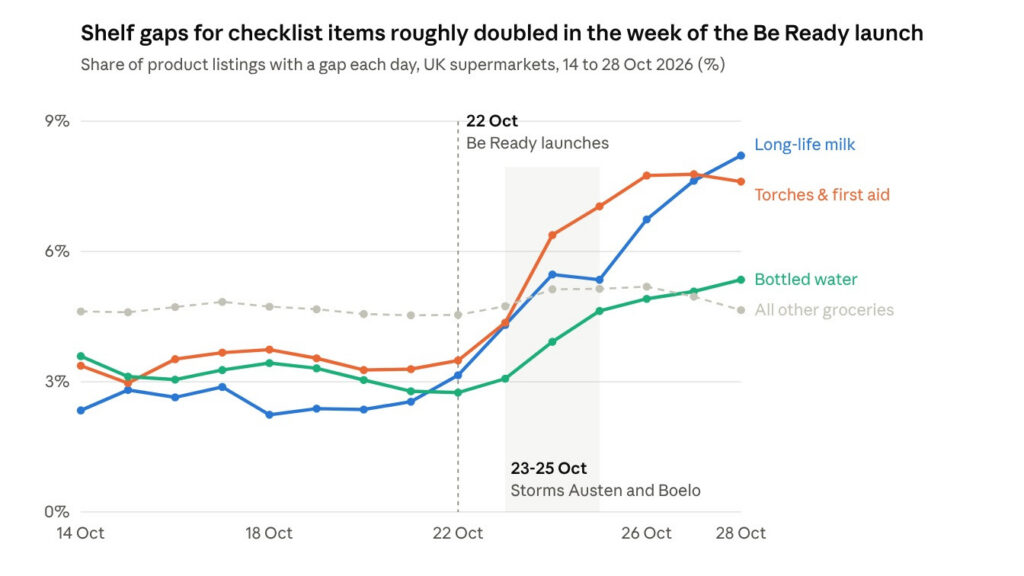
Independent shelf data from UK supermarkets shows gaps on long-life milk shelves tripled after the government’s Be Ready campaign launch. Torches and bottled water ran short too, while the tin aisle looked much like any other late October.
On 22 October, the Cabinet Office asked every UK household to keep three days of supplies at home: water, food that needs no cooking, a torch, a radio and batteries. In the days that followed, retailers reported sharp jumps in sales of tins, torches and wind-up radios.
Sales figures show what went through the till. Paired with the stock count on file, they tell a store what it should have, not what’s actually on the shelf. Most stores only check that with a full stocktake a few times a year, so a product can sell out and the system can still say it’s there. Focal Systems’ cameras scan supermarket shelves across the UK around the clock, so they show what sales data can’t: how often a shopper reached for a product and found the shelf empty. Here’s what the shelves showed.
Britain stocked up for a power cut
The biggest surprise was long-life milk. It keeps for months without a fridge, which makes it an obvious pick if you’re planning for the power going out. By 28 October, gaps on long-life milk shelves were three times what they had been the day before the launch, and still rising.
Torches and first aid moved fastest. Gaps on those shelves more than doubled within five days. Bottled water gaps nearly doubled over the week, at a time of year when they usually fall: in the same week of 2025, water gaps dropped by about a quarter.
Put together, the items that ran short look like a blackout kit: light, water and milk that doesn’t need a fridge.
The same week brought Storm Austen on 23 October and Storm Boelo over 24 and 25 October, and thousands of homes lost power, so the weather will account for part of the jump. But milk and water gaps kept climbing every day through 28 October, after both storms had passed. The clocks going back and Halloween fall in this week every year too, and in 2025 torch gaps barely moved.
The tin aisle looked like a normal October
The headlines expected a rush on tinned food. On the shelf, gaps for beans, tinned veg and tinned fish did rise by around a quarter in September. But late October is always a heavy month for tins, and the same categories rose by as much or more in the same weeks of 2025. Against a normal year, tinned food gaps were flat to slightly lower.
What did change was pack size. Heinz Beanz 6-packs had four times their usual level of gaps, and Princes tuna 4-packs went the same way. Napolina’s 4-pack of plum tomatoes had three and a half times the usual amount of gaps, while the single tin barely moved. Shoppers stuck to the tins they already eat and bought them in bulk.
Stores kept up
More gaps didn’t mean longer gaps. Across all products, the time from a camera spotting an empty shelf to staff completing the restock held at a little over four hours, the same as the month before. Torches and first aid, the category under the most pressure, were refilled 10% faster than usual, in just over five hours.
“The government asked people to be alert, not alarmed, and that’s how shoppers behaved,” said Kevin Sturdevant, VP of Customer Support and Analytics at Focal Systems. “They bought what was on the list, often in bigger packs, and the stores that could see their gaps refilled them as quickly as in a normal week. When demand jumps overnight, knowing which shelf is empty right now is what keeps a spike from becoming a shortage.”
About the data
Figures come from Focal Systems’ shelf-gap detections in UK supermarkets. The week of 22 to 28 October 2026 is compared with 24 September to 21 October 2026 and with the same weeks in 2025. The measure is the share of product listings with at least one gap each day, averaged over the week. It is not the share of stores with empty shelves. Adjusted figures remove each category’s change in the same week of 2025 and the change across all other grocery products. Restock times measure minutes from gap detection to a completed restock task, for 2026 only.
About Focal Systems: Focal Systems builds shelf intelligence for grocery retail. Its 300,000 cameras carry out 40 million shelf scans a day, showing stores what is missing and where in close to real time.