
How retailers are unlocking tens of thousands of dollars in recoverable inventory, every month, per store, with overhead vision technology.
Walk the backroom of almost any grocery store, and you’ll find it: pallets stacked ceiling-high, cases wedged onto overheads above the shelves, product sitting in the dark while the sales floor runs empty. It’s a problem that’s been tolerated for decades, not because retailers don’t care, but because no one could see it clearly enough to act on it.
Overhead inventory, often called “top stock” represents one of retail’s most persistent blind spots. Cases stored above the shelf line, either in the back room or on the sales floor, are invisible to demand planning systems, difficult to audit manually, and too easy to forget. The result: a product that should be on the shelf, growing revenue, is instead gathering dust. And the financial toll is larger than most operators realize.
A new wave of AI-powered camera vision is changing this with real, measurable results already emerging from early deployments.
The Top Stock Problem: Bigger Than It Looks
In a typical grocery store, overhead inventory can represent thousands of dollars in sellable product at any given time. Cases are placed above shelf bays during receiving and overnight stocking and then, too often, forgotten. Night crews move on. The day staff aren’t sure what’s up there. Inventory management systems track what was received, not what’s accessible.
The downstream effects compound quickly:
- Out-of-stocks on the sales floor while the item sits overhead, undetected
- Manual audits that consume 4–8 hours per week of labor with limited accuracy
- Inventory records that don’t reflect true store-level availability
- Replenishment decisions made without visibility to what’s on the shelves vs in boxes
- Product that expires or becomes unsellable while trapped in overhead storage
The problem isn’t unique to one retailer or format. It’s a structural byproduct of how grocery stores are built and staffed and it’s been accepted as an unavoidable cost of doing business. Until now.
Computer Vision Meets the Overhead Challenge
Focal Systems has developed a dedicated vision module that brings continuous, automated visibility to top stock for the first time. Using high-resolution (8MP) cameras already deployed throughout the store, the system reads ArUco-style labels placed on cases stored in the overhead area. Each scan identifies the product, its quantity, and its location and feeds that data directly into the store’s inventory management system.
The module doesn’t just log what’s there. It acts on it. By cross-referencing overhead inventory data with real-time shelf-level out-of-stock and low-stock signals, the system can:
- Flag inaccurate inventory records and trigger corrective counts
- Identify which items currently stored overhead fit on-shelf gaps right now
- Surface replenishment tasks for store associates — precise, prioritized, and actionable
- Reduce over-accumulation by making overhead stock visible in demand planning
Critically, all of this happens continuously, not once or twice a day, but every hour, with no human effort required to initiate a scan.
Pilot Results: ShopRite / Village Super Market
In the first live deployment, a single ShopRite location operated by Village Super Market showed results within the first month that were striking:
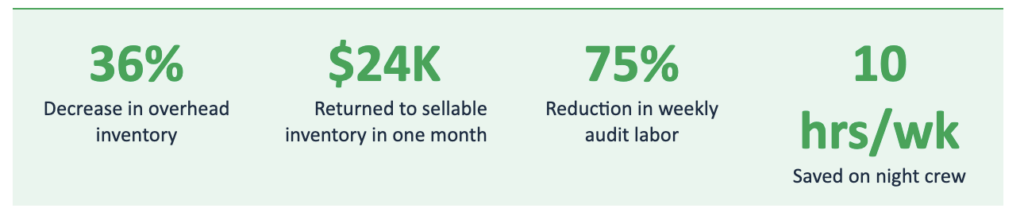
These figures come from a single store, in a single month. Extrapolated across a 36-store footprint, the cumulative impact on working capital, labor efficiency, and on-shelf availability becomes substantial. Village Super Market has already approved expansion to four additional stores, with the rollout continuing through the remainder of 2026.
Why Computer Vision Outperforms Robotic Alternatives
The main competitive alternative for overhead visibility today involves robotic systems, autonomous units that navigate store aisles to scan price tags and gather shelf data. While robots have attracted significant investment in the retail technology space, their limitations in this context are significant:
- Robots typically complete only 1–2 scans per day, leaving hours-long gaps in data freshness
- They cannot operate during peak shopping periods, which are the exact times when replenishment decisions are most critical
- Battery interruptions, technical issues, and maintenance windows create unpredictable data blackouts
- Output is often delivered as long-form email reports rather than direct, task-level actions for store associates
- Shopper experience impact: carts, displays, and crowded aisles limit robot mobility during busy periods
Camera-based vision systems, by contrast, are fixed infrastructure. They scan continuously, 24 hours a day, without interruption. They don’t block aisles, don’t require recharging, and don’t get slowed down by holiday foot traffic. The data they generate is fresher, more consistent, and more directly actionable.
For retailers evaluating technology investments, this difference matters: not just in output quality, but in total cost of ownership and operational simplicity.
The ROI Case: Focal’s Shelf AI Core Use Case
Retail technology investments are often evaluated on payback period and incremental value per store. Focal’s platform has already established a strong ROI benchmark through its core use case of reducing out-of-stocks, improving on-shelf availability, and enabling labor reallocation. The Top Stock module extends that return by addressing a value stream that was previously entirely invisible.
The $24,000 returned to sellable inventory in one month at a single store is not a one-time catch-up figure. It reflects a structural improvement in how overhead inventory is tracked and acted upon, a recurring benefit that compounds across stores and months. When you add the labor savings (12 combined hours per week per store), the financial case stands on its own.
For operators managing large store footprints, the math is straightforward: if one store recovers $24K/month in previously stranded inventory, a 36-store chain is looking at potential recovery in the range of $1M+ per month — capital that was already paid for and sitting on shelves, just in the wrong place.
What Comes Next: Scaling and Integration
The Top Stock module is currently in phased rollout across Village Super Market’s eligible store base. International interest is also emerging. Retailers in the UK have expressed interest in piloting the module, and Focal is actively developing its roadmap for cross-market expansion.
As the technology matures, the integration between overhead visibility and the broader store operations platform will deepen. Focal Systems provides this unified view: shelf, back stock, and overhead continuously updated, automatically actioned, and fully integrated into the systems retailers already use to run their stores.
The Bottom Line
Top stock has been a silent drain on retail profitability for as long as stores have had shelves. The inventory is there. The revenue opportunity is there. What’s been missing is visibility that is consistent, automated, and actionable.
AI vision technology now makes that visibility possible, at a cost and scale that justifies broad deployment. For retailers willing to look up — literally — the returns are already proving the case.
The Hidden Cost of What Sits Above the Shelf:
What is top stock, and why is it a problem for grocery retailers?
Top stock refers to cases stored above the shelf line, either on the sales floor or in the back room, that are difficult to audit and often forgotten. This leads to out-of-stocks on the sales floor while sellable product sits overhead, undetected.
How does Focal Systems’ AI vision technology track overhead inventory?
Focal Systems uses high-resolution cameras already deployed throughout the store to read ArUco-style labels on cases stored in the overhead area. Each scan identifies the product, its quantity, and its location, and feeds that data directly into the store’s inventory management system every hour.
Can the system determine whether overhead stock can be moved to the shelf?
Yes. The system cross-references overhead inventory data with real-time shelf-level out-of-stock and low-stock signals, then surfaces prioritized replenishment tasks for store associates only when a full case pack can be added to the sales floor.
How much labor does the system save compared to manual audits?
Manual top stock audits typically consume 4 to 8 hours per week per store. The AI vision system automates this process continuously, with pilot results at ShopRite showing 12 combined hours of labor saved per week at a single location.
What results did the ShopRite pilot produce?
In the first live deployment at a single ShopRite location operated by Village Super Market, the system returned $24,000 to sellable inventory within the first month, representing a recurring structural improvement rather than a one-time catch-up figure.
How does camera-based vision compare to robotic scanning systems?
Robots typically complete only one to two scans per day and cannot operate during peak shopping hours, creating significant gaps in data freshness. Fixed camera systems scan continuously, 24 hours a day, without interruption, blocked aisles, or recharging requirements
What is the potential financial impact across a larger store footprint?
If a single store recovers $24,000 per month in previously stranded inventory, a 36-store chain could see potential recovery in the range of $1 million or more per month, capital that was already paid for and sitting in the wrong place..