
If it feels like Halloween is popping up in stores earlier and earlier each year, that’s because it is. And now there’s shelf-level data to prove it.
“Summerween” has been a recurring trend for a few years thanks to Gen Z’s love for the season. According to Mars latest Tricks, Treats and Trends report, 59% of Gen Z are aware of Summerween and 30% are participating in it. So we decided to look at the shelves to see what’s going on in stores. We pulled shelf-scan data across UK grocery stores from 2024 through today to see whether the stores are following the trend. The answer is a giant YES, and the pattern is remarkably consistent: every year in this dataset, Halloween products have landed on shelves earlier than the year before, in bigger volume, and across more product categories than candy and costumes alone.
What the Data Shows
Using shelf-scan records from UK grocery stores, we tracked the first date each Halloween product appeared on shelf, year over year, from June through December (excluding January–May carryover stock from the prior season).
The clearest comparison controls for everything except timing: looking only at the identical product at the identical store across both years, 82% of 1,008 matched products went on shelf earlier in 2025 than in 2024, by a median of 9 days. To be clear, that’s not a function of more stores being tracked or a bigger assortment; it’s the same items at the same locations, just arriving sooner.
The pattern isn’t slowing down. Comparing shelf activity by August 12 each year from 2024 to 2026, the ramp has accelerated for three straight years:
| Year | Items on shelf by Aug 12 | Median first-shelf date |
| 2024 | 3 | September 21 |
| 2025 | 24 | September 16 |
| 2026 | 39 (and counting) | — |
By the numbers, the earliest 10% of 2025’s Halloween assortment was on shelf by August 27, two weeks earlier than the same benchmark in 2024. And 2026 is on pace to beat that again: every matched product re-tracked so far this year has arrived earlier than it did in 2025.
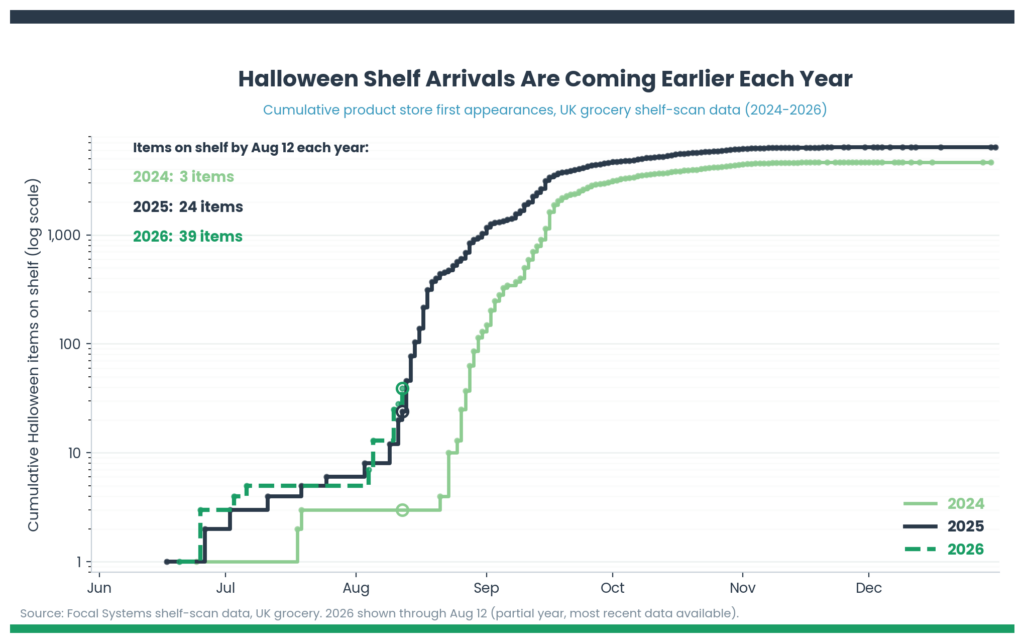
[Chart: Summerween_Chart.png — cumulative Halloween shelf appearances, 2024–2026]
It’s Not Just Candy Anymore
The Halloween assortment itself is getting bigger, not just earlier. Retailers tracked in this dataset carried 76 distinct Halloween products in 2024 and 124 in 2025, a 63% increase in range.
Decor and homeware (tumblers, garlands, light-up novelties) consistently arrive first each year, ahead of candy and bakery, and it’s also the fastest-growing category — more than doubling year over year. Halloween has also pushed well beyond the candy aisle into everyday grocery categories: Halloween-branded pizza, doughnuts, burgers, and cake-decorating kits, plus licensed tie-ins that barely existed in the 2024 range.
Why This Matters for Retailers
Seasonal resets are a coordination problem, not a single decision. Getting Halloween on the shelf two to three weeks earlier means earlier planogram resets, earlier supplier deliveries, and, most importantly, earlier visibility into whether the reset actually happened correctly across hundreds of stores at once.
That last part is where retailers are still flying blind. A seasonal reset that should take a week can end up taking three if nobody can see, store by store, which locations have actually executed it. The same shelf-monitoring visibility that lets us measure this trend at a category level is exactly what retail teams need at the individual-store level: real-time confirmation that new seasonal ranges are actually on shelf, not just scheduled to be.
Methodology & Data Notes
This analysis uses first-appearance shelf-scan records for Halloween-labeled products across UK grocery stores, restricted to June through December each year to exclude carryover stock still being detected from the prior season. Comparisons for 2024 and 2025 use complete calendar-year data; 2026 figures are shown through August 12, the most recent date available, and are noted as partial-year wherever used. The matched-product analysis (82% earlier in 2025 vs. 2024) compares the same UPC at the same store across both years to isolate timing from changes in store count or assortment size.
Frequently Asked Questions
What is Summerween?
Summerween is the trend of Halloween products — candy, decor, costumes and themed food — appearing in stores while it is still summer, months ahead of the traditional autumn buildup. It began as a Gen Z social-media trend, and retailers are now following it: Focal Systems recorded Halloween stock in UK grocery stores by mid-August 2026.
Is Halloween really arriving on shelves earlier each year, or does it just feel that way?
It is measurable, not perception. Comparing the same products at the same UK grocery stores across both years, Focal Systems found 82% arrived on shelf earlier in 2025 than in 2024, by a median of 9 days. The overall median first-shelf date moved from September 21, 2024 to September 16, 2025.
Why are stores selling Halloween products in August?
Retailers are responding to earlier consumer demand. Mars’ 2026 Tricks, Treats and Trends report, based on a US consumer survey, found 59% of Gen Z aware of Summerween and 30% already participating. Focal Systems shelf data shows UK grocers acting on it: the Halloween range grew 63%, from 76 products in 2024 to 124 in 2025.
What Halloween products arrive in stores first?
Halloween has moved well beyond the confectionery aisle. Focal Systems recorded Halloween-branded pizza, doughnuts, burgers and cake-decorating kits in UK grocery stores in 2025, alongside licensed character tie-ins that barely existed in the 2024 range — part of a 63% increase in total Halloween assortment.
What Halloween products do stores sell besides candy and costumes?
Unified platforms connect shopper data, loyalty behavior, and purchase history across all channels. This allows retailers to deliver personalized, AI-driven offers that work seamlessly across first-party and third-party products without creating conflicting promotions.
When do retailers reset shelves for Halloween?
Halloween resets in UK grocery now begin in early August, with most of the range landing through September. Focal Systems shelf data shows the median first-shelf date moved 5 days earlier between 2024 and 2025, meaning planogram resets and supplier deliveries are being pulled forward year over year.
How can retailers confirm a seasonal reset actually happened in every store?
Scheduled resets and executed resets are not the same thing. Camera-based shelf monitoring confirms, store by store, whether a new seasonal range is physically on shelf. Focal Systems tracks on-shelf availability and planogram compliance across hundreds of thousands of cameras globally, giving retailers same-day visibility instead of end-of-season reporting.